📄 English | 中文
 𝚃𝚎𝚡𝚃𝚎𝚕𝚕𝚎𝚛

https://github.com/OleehyO/TexTeller/assets/56267907/b23b2b2e-a663-4abb-b013-bd47238d513b
TexTeller is an end-to-end formula recognition model based on ViT, capable of converting images into corresponding LaTeX formulas.
TexTeller was trained with 550K7.5M image-formula pairs (dataset available here), compared to LaTeX-OCR which used a 100K dataset, TexTeller has stronger generalization abilities and higher accuracy, covering most use cases (except for scanned images and handwritten formulas).
We will soon release a TexTeller checkpoint trained on a 7.5M dataset
🔄 Change Log
- 📮[2024-03-25] TexTeller 2.0 released! The training data for TexTeller 2.0 has been increased to 7.5M (about 15 times more than TexTeller 1.0 and also improved in data quality). The trained TexTeller 2.0 demonstrated superior performance in the test set, especially in recognizing rare symbols, complex multi-line formulas, and matrices.
There are more test images here and a horizontal comparison of recognition models from different companies.
🔑 Prerequisites
python=3.10
Warning
Only CUDA versions >= 12.0 have been fully tested, so it is recommended to use CUDA version >= 12.0
🖼 About Rendering LaTeX as Images
-
Install XeLaTex and ensure
xelatexcan be called directly from the command line. -
To ensure correct rendering of the predicted formulas, include the following packages in your
.texfile:\usepackage{multirow,multicol,amsmath,amsfonts,amssymb,mathtools,bm,mathrsfs,wasysym,amsbsy,upgreek,mathalfa,stmaryrd,mathrsfs,dsfont,amsthm,amsmath,multirow}
🚀 Getting Started
-
Clone the repository:
git clone https://github.com/OleehyO/TexTeller -
After installing pytorch, install the project's dependencies:
pip install -r requirements.txt -
Enter the
TexTeller/srcdirectory and run the following command in the terminal to start inference:python inference.py -img "/path/to/image.{jpg,png}" # use -cuda option to enable GPU inference #+e.g. python inference.py -img "./img.jpg" -cuda
Note
The first time you run it, the required checkpoints will be downloaded from Hugging Face
🌐 Web Demo
First, ensure that poppler is correctly installed and added to the PATH (so that the pdftoppm command can be directly used in the terminal).
Then, go to the TexTeller/src directory and run the following command:
./start_web.sh
Enter http://localhost:8501 in a browser to view the web demo.
Tip
You can change the default configuration of
start_web.sh, for example, to use GPU for inference (e.g.USE_CUDA=True) or to increase the number of beams (e.g.NUM_BEAM=3) to achieve higher accuracy
Important
If you want to directly render the prediction results as images on the web (for example, to check if the prediction is correct), you need to ensure xelatex is correctly installed
📡 API Usage
We use ray serve to provide an API interface for TexTeller, allowing you to integrate TexTeller into your own projects. To start the server, you first need to enter the TexTeller/src directory and then run the following command:
python server.py # default settings
You can pass the following arguments to server.py to change the server's inference settings (e.g. python server.py --use_gpu to enable GPU inference):
| Parameter | Description |
|---|---|
-ckpt |
The path to the weights file, default is TexTeller's pretrained weights. |
-tknz |
The path to the tokenizer, default is TexTeller's tokenizer. |
-port |
The server's service port, default is 8000. |
--use_gpu |
Whether to use GPU for inference, default is CPU. |
--num_beams |
The number of beams for beam search, default is 1. |
--num_replicas |
The number of service replicas to run on the server, default is 1 replica. You can use more replicas to achieve greater throughput. |
--ncpu_per_replica |
The number of CPU cores used per service replica, default is 1. |
--ngpu_per_replica |
The number of GPUs used per service replica, default is 1. You can set this value between 0 and 1 to run multiple service replicas on one GPU to share the GPU, thereby improving GPU utilization. (Note, if --num_replicas is 2, --ngpu_per_replica is 0.7, then 2 GPUs must be available) |
Note
A client demo can be found at
TexTeller/client/demo.py, you can refer todemo.pyto send requests to the server
🏋️♂️ Training
Dataset
We provide an example dataset in the TexTeller/src/models/ocr_model/train/dataset directory, you can place your own images in the images directory and annotate each image with its corresponding formula in formulas.jsonl.
After preparing your dataset, you need to change the DIR_URL variable to your own dataset's path in .../dataset/loader.py
Retraining the Tokenizer
If you are using a different dataset, you might need to retrain the tokenizer to obtain a different dictionary. After configuring your dataset, you can train your own tokenizer with the following command:
-
In
TexTeller/src/models/tokenizer/train.py, changenew_tokenizer.save_pretrained('./your_dir_name')to your custom output directoryIf you want to use a different dictionary size (default is 10k tokens), you need to change the
VOCAB_SIZEvariable inTexTeller/src/models/globals.py -
In the
TexTeller/srcdirectory, run the following command:python -m models.tokenizer.train
Training the Model
To train the model, you need to run the following command in the TexTeller/src directory:
python -m models.ocr_model.train.train
You can set your own tokenizer and checkpoint paths in TexTeller/src/models/ocr_model/train/train.py (refer to train.py for more information). If you are using the same architecture and dictionary as TexTeller, you can also fine-tune TexTeller's default weights with your own dataset.
In TexTeller/src/globals.py and TexTeller/src/models/ocr_model/train/train_args.py, you can change the model's architecture and training hyperparameters.
Note
Our training scripts use the Hugging Face Transformers library, so you can refer to their documentation for more details and configurations on training parameters.
🚧 Limitations
-
Does not support scanned images and PDF document recognition
-
Does not support handwritten formulas
📅 Plans
-
Train the model with a larger dataset (7.5M samples, coming soon) -
Recognition of scanned images
-
PDF document recognition + Support for English and Chinese scenarios
-
Inference acceleration
-
...
💖 Acknowledgments
Thanks to LaTeX-OCR which has brought me a lot of inspiration, and im2latex-100K which enriches our dataset.
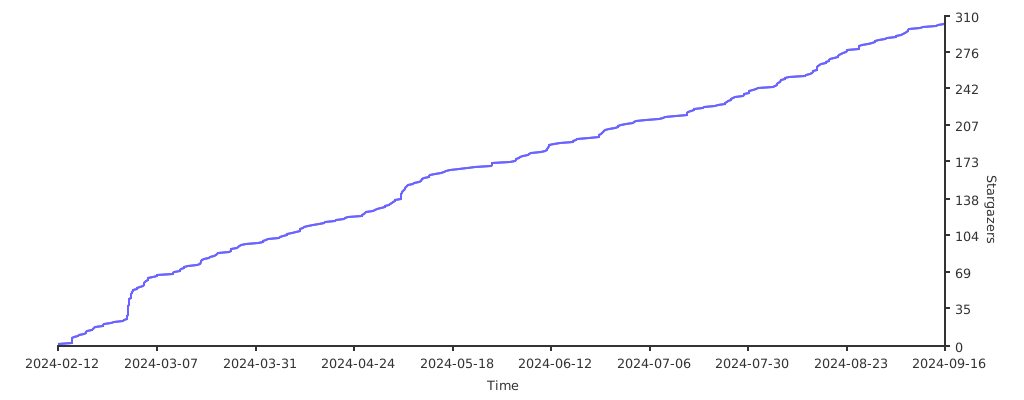
⭐️ Stargazers over time